

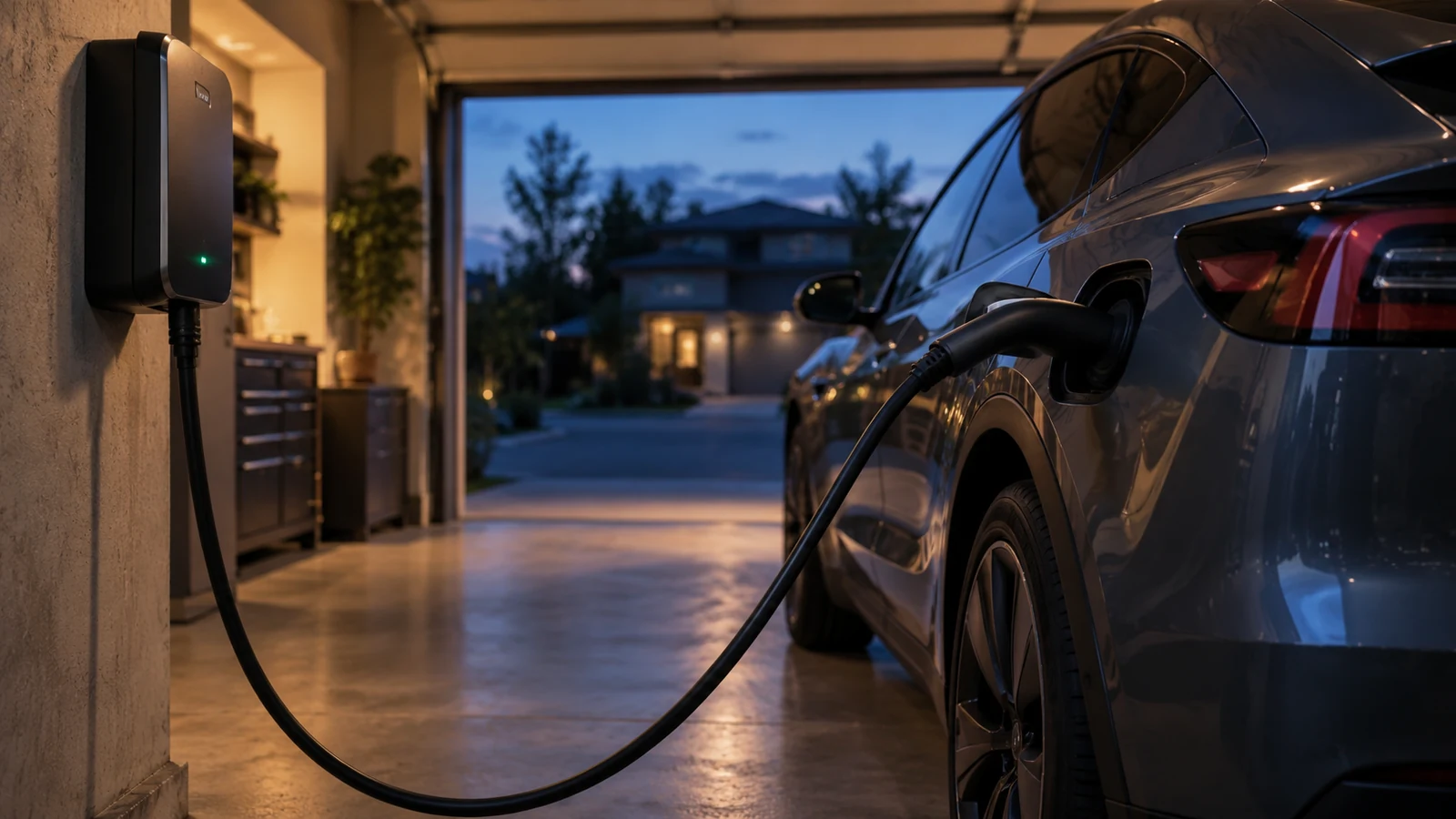
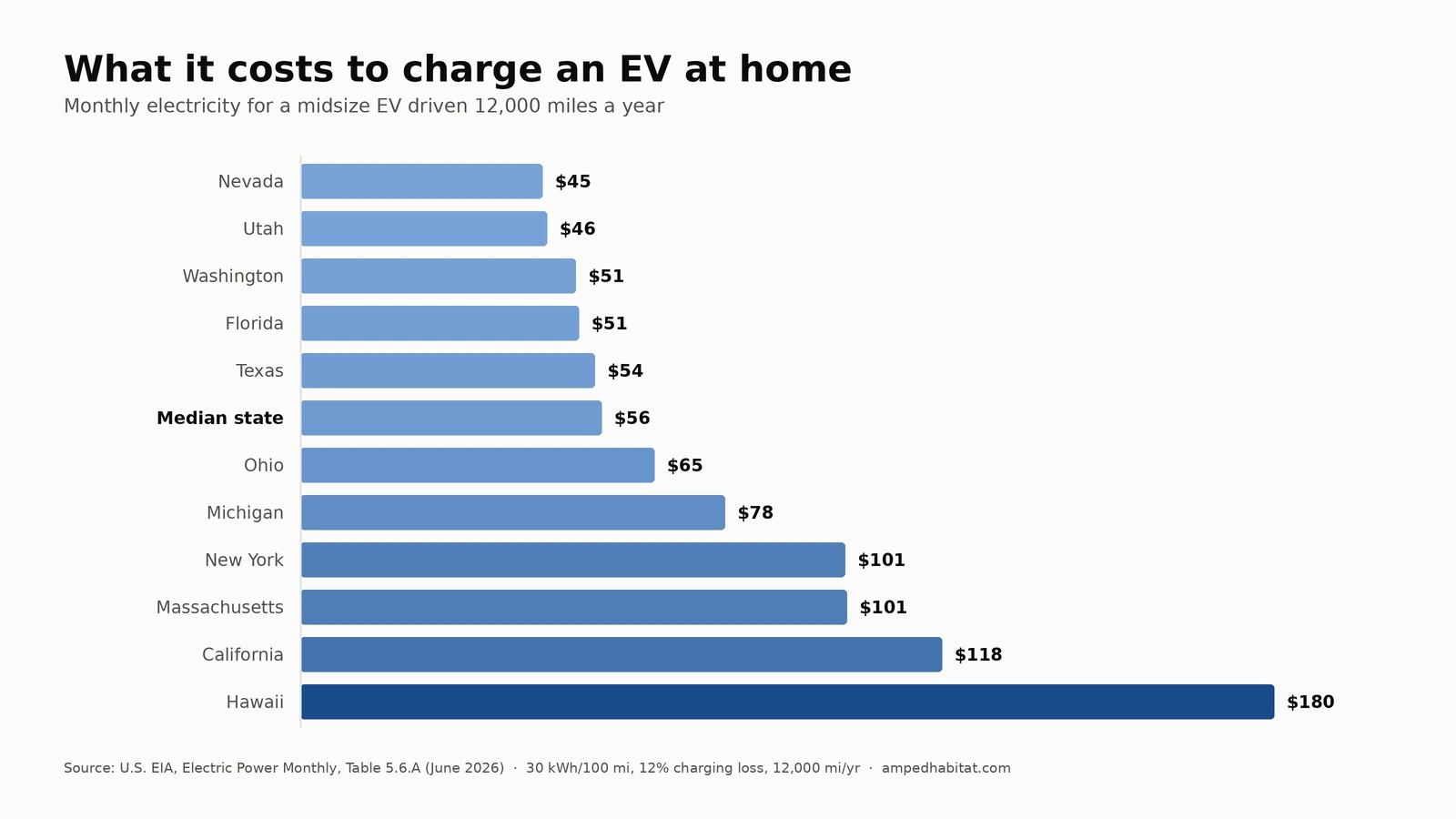
Charging an EV at home costs most U.S. drivers between $45 and $70 a month. In 35 of the 51 states and territories the EIA tracks, a midsize EV driven 12,000 miles a year lands inside that band. The number that matters is cost per mile, and it comes down to three things: your electricity rate, your car's efficiency, and the energy lost as heat while charging. Enter your details below to get your own figure, built on the U.S. Energy Information Administration's June 2026 residential rates for all 51 states and D.C.
EV Charging Cost Calculator
Sets your rate from EIA data
Override with your actual bill rate
U.S. average is about 13,500
Exact EPA numbers: fueleconomy.gov
From the EPA window sticker
The rest is priced as DC fast charging
Typical U.S. public network pricing
Energy the wall supplies but the battery never stores
Set to 0 to skip the comparison
Use your local pump price
| Energy stored in the battery | — |
|---|---|
| Energy drawn from the wall | — |
| Wasted to charging losses | — |
| Home charging cost | — |
| Public DC fast charging cost | — |
| Equivalent gas car cost | — |
Estimates only. Your utility's time-of-use windows, demand charges, seasonal tiers and fixed monthly fees will move the real number.
Why charging losses change the answer
Most published EV running-cost figures quietly ignore a real cost: the electricity your meter records but your battery never stores. On a Level 2 home charger, roughly 10–15% of the energy drawn from the wall is lost as heat in the onboard charger, the cabling and battery thermal management. Level 1 charging on a standard 120V outlet is worse, often losing 15–20%, because the car's overhead runs for far longer at a much lower rate.
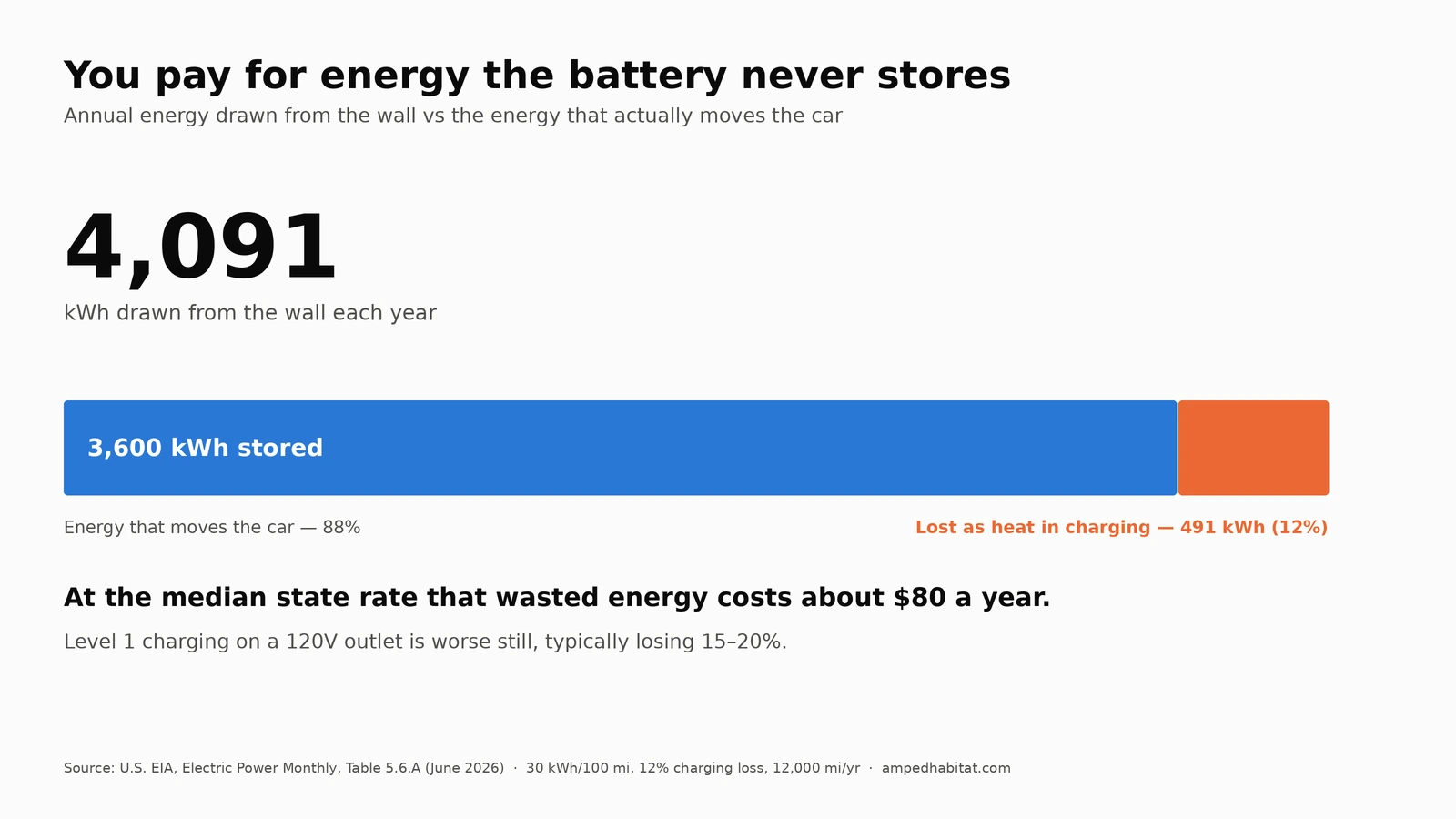
That gap matters because you are billed for what the wall supplies, not what the battery keeps. A car rated at 30 kWh per 100 miles actually pulls closer to 34 kWh per 100 miles through a Level 2 charger. Over 12,000 miles a year that is roughly 480 kWh of electricity you pay for and never drive on. The calculator above bills you for wall energy, which is why its figures run slightly higher than the manufacturer's efficiency rating alone would suggest.
Residential electricity rates by state
These are average residential rates published by the U.S. Energy Information Administration in Electric Power Monthly, Table 5.6.A, for June 2026. The national average sits at 19.42¢/kWh and the median state at 16.32¢/kWh — a gap worth noting, because a handful of very expensive states pull the average well above what most Americans actually pay.
The "cost per mile" column assumes a midsize sedan at 30 kWh/100 mi with a 12% charging loss, charged entirely at home.
| State | ¢/kWh | Cost per mile | 12,000 mi/yr |
|---|
Rates are statewide residential averages. Your own utility, rate plan and time-of-use schedule can differ substantially from the state figure.
AmpedHabitat, "EV Charging Cost Calculator: Real Electricity Math by State (2026)." Electricity rates: U.S. EIA, Electric Power Monthly, Table 5.6.A, June 2026. https://www.ampedhabitat.com/
Methodology
Every figure the calculator produces follows the same five steps, and all of them are visible in the breakdown table so you can check the arithmetic yourself:
- Battery energy. Annual miles multiplied by your efficiency rating, in kWh per 100 miles. This is the energy that actually moves the car.
- Wall energy. Battery energy divided by charging efficiency. A 12% loss means dividing by 0.88, not multiplying by 1.12 — a distinction that understates the cost by roughly 1.5% if you get it backwards.
- Split by location. Wall energy is divided between home charging, billed at your state or custom rate, and public DC fast charging, billed at its own per-kWh price.
- Gas comparison. Annual miles divided by MPG, multiplied by the pump price. No maintenance, insurance or depreciation is included on either side.
- Per-mile cost. Total annual electricity cost divided by annual miles.
What this deliberately excludes: fixed monthly utility fees, demand charges, the installed cost of a Level 2 charger, federal or state incentives, and any solar generation offsetting your draw. Each of those is real, and each is specific enough to your situation that folding a national average into the result would make it less accurate, not more.
The rest of the EV charging guides
This calculator is the starting point. These cover the decisions it cannot make for you:
Setting up home charging
- 240V Outlet for EV Charging: The Hidden Cost
What the electrical work actually costs before the charger itself.
- Level 2 Charger Charging Slowly? Diagnostic Guide
Why real charging speed falls short of the rated figure.
- EV Charger Extension Cords: What's Safe
The safety limits that matter before you improvise.
Choosing a charger
- Wallbox Pulsar Plus vs Tesla Wall Connector
Direct comparison of the two most common picks.
- ChargePoint Home Flex Review
Specs, installation and the verdict.
- JuiceBox 40 Review
Worth buying after Enel X's exit?
- Best Portable EV Chargers
Categories that matter, not marketing claims.
Running costs and real-world conditions
- Wallbox Pulsar Plus Running Costs
The full electricity math worked through on one charger.
- Tesla Model Y Charging Guide
Speeds, times, costs and the settings that matter.
- EV Charging in Summer Heat
What hot weather does to charging speed and battery life.
- SolarEdge EV Charger Not Syncing With Solar
Fixes for charging on your own generation.
- Portable EV Chargers and the 120kW Myth
What portable units can and cannot deliver.
Frequently asked questions
How much does it cost to charge an EV at home per month?
For most U.S. drivers, $30 to $60. At the median state rate of 16.32¢/kWh, a midsize EV driven 12,000 miles a year costs roughly $56 a month to charge entirely at home. In Hawaii the same car costs about $180; in Nevada, the cheapest state, about $45.
Is charging an EV cheaper than buying gas?
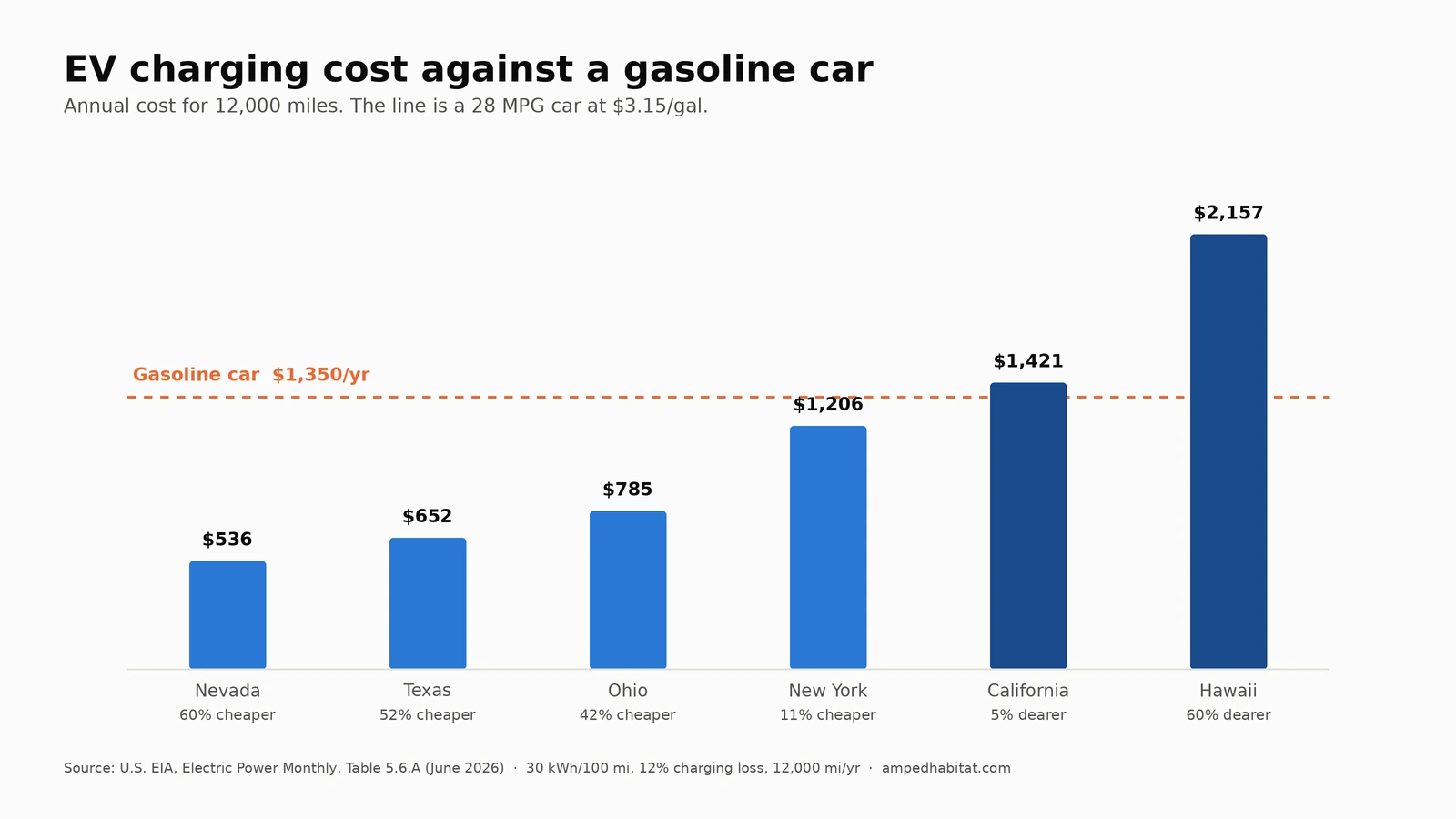
Almost always, but the margin varies enormously by state. At the median rate against a 28 MPG gas car at $3.15/gal, electricity runs roughly a third of the fuel cost. In the most expensive states the gap narrows sharply, and in Hawaii it can reverse.
How much energy is lost when charging an EV?
Roughly 10–15% on a Level 2 home charger and 15–20% on a Level 1 120V outlet. You are billed for that lost energy because your meter measures what the wall supplies, not what the battery stores.
Does time-of-use billing change the calculation?
Substantially. Many utilities price overnight electricity at half the daytime rate or less, and EVs charge overnight by default. If you are on a time-of-use plan, enter your off-peak rate rather than the state average.
Where do these electricity rates come from?
The U.S. Energy Information Administration's Electric Power Monthly, Table 5.6.A, for June 2026. They are statewide residential averages covering all 50 states and the District of Columbia.