

Short answer: A 240V outlet can be a practical way to charge an EV at home, but the receptacle itself is rarely the main cost. Panel capacity, circuit size, wire route, permits, GFCI requirements, outdoor protection, and installation access usually matter more. And 240V does not define charging speed: the circuit, EVSE setting, and the vehicle’s onboard AC charger all set the real limit.
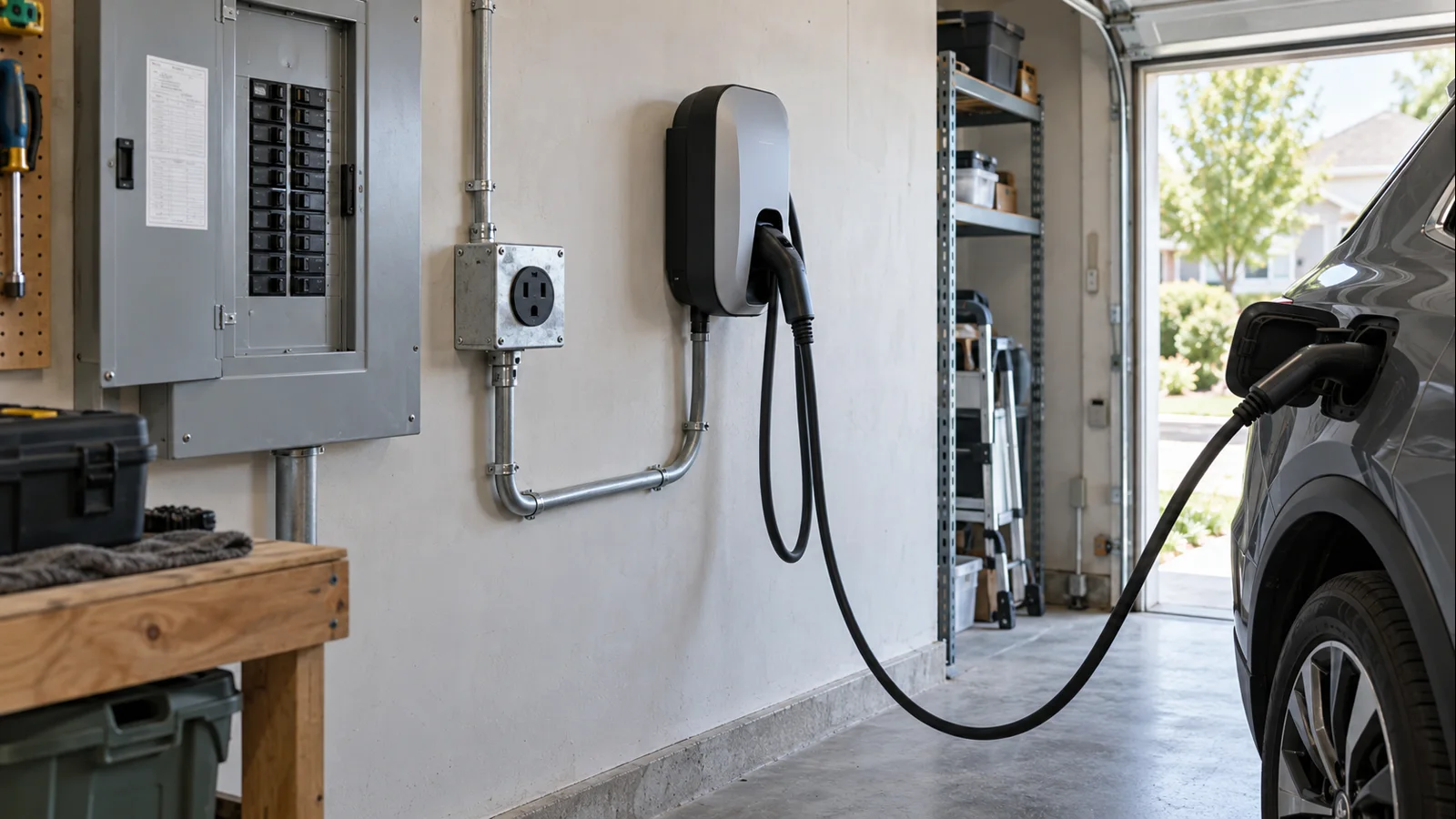
What a 240V EV outlet actually gives you
Residential Level 2 charging commonly uses 240V power, usually on a dedicated circuit. The U.S. Department of Energy’s Alternative Fuels Data Center describes 240V as typical for residential Level 2 charging, but voltage alone is only one part of the equation.
The EVSE—the wall unit or portable charging equipment—advertises how much current it can supply. The vehicle’s onboard AC charger determines how much AC power the car can actually accept. The lower limit wins. That is why a charger labeled for 48 amps does not make every EV charge at 48 amps.
Amps and kilowatts are different measurements. Amps describe current; kilowatts describe power. At 240V, 32A is about 7.7kW, 40A is 9.6kW, and 48A is about 11.5kW. Those are input-side power figures, not guaranteed battery charging rates after conversion losses or vehicle limits.
The biggest misconception: a 50A outlet is not 50A continuous charging
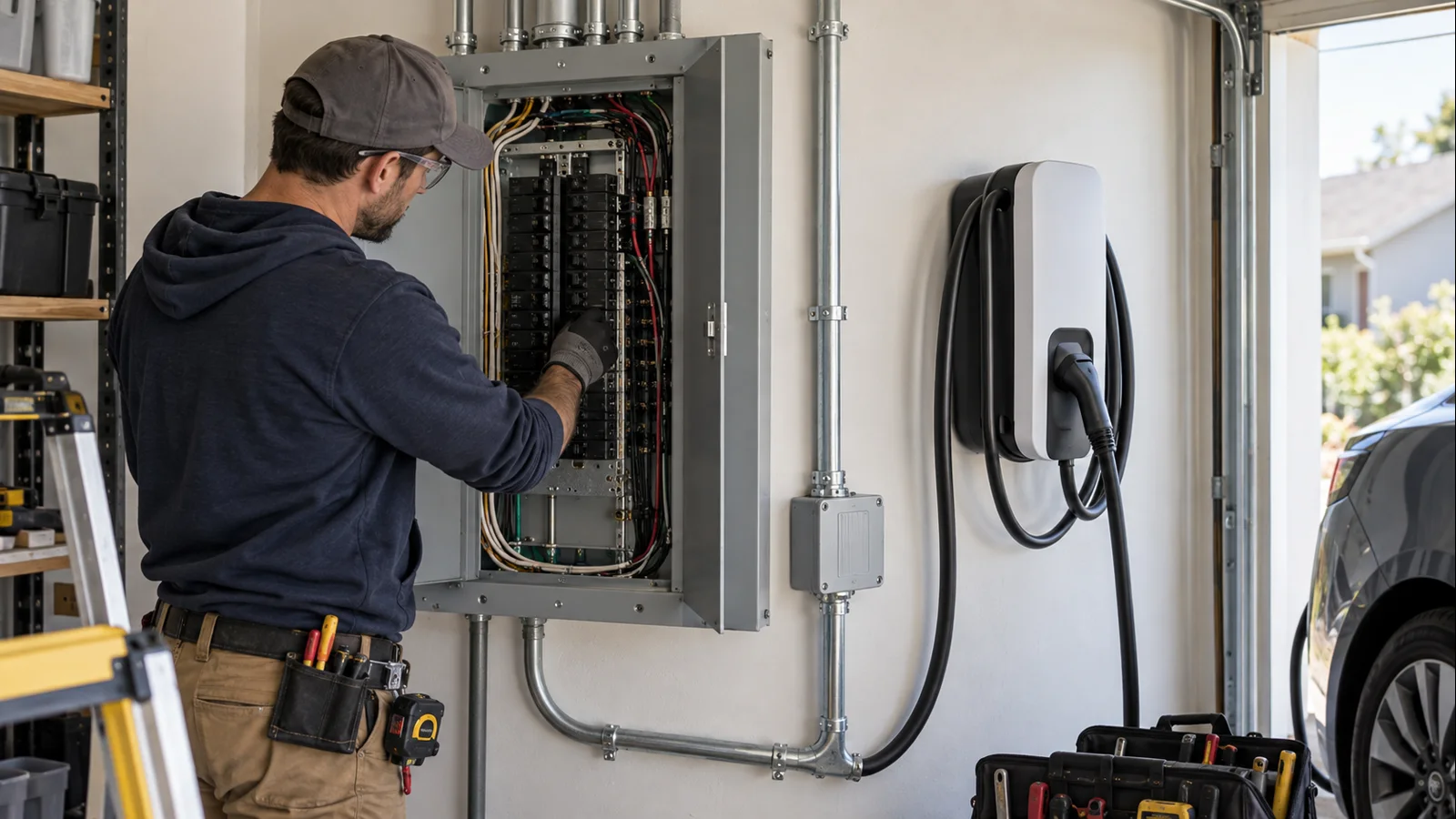
EV charging is treated as a continuous load, so the branch circuit must be sized above the continuous charging current. ChargePoint’s current Home Flex installation guide states that the circuit must be rated for 125% of the maximum load. Its published configurations show a 40A circuit supporting 32A charging and a 50A circuit supporting 40A charging. ChargePoint allows plug-in Home Flex installations on those two circuit sizes; its 48A and 50A settings require hardwiring.
Tesla provides another useful example. The current Mobile Connector guidance lists the NEMA 14-50 adapter on a 240V/50A breaker but caps Mobile Connector output at 32A. Tesla’s optional NEMA 6-50 adapter is also capped at 32A. So buying a 50A receptacle does not automatically produce 40A or 50A charging.
For a hardwired example, Tesla’s Universal Wall Connector documentation maps a 60A breaker to 48A maximum output and about 11.5kW at 240V, a 50A breaker to 40A and 9.6kW, and a 40A breaker to 32A and 7.6kW. Tesla also notes that actual charging can be lower because of the vehicle’s onboard charger.
If a car is not reaching the number printed on the EVSE, see AmpedHabitat’s guide to slow Level 2 EV charging. Tesla owners can also compare vehicle-side limits in the Model Y home-charging guide.
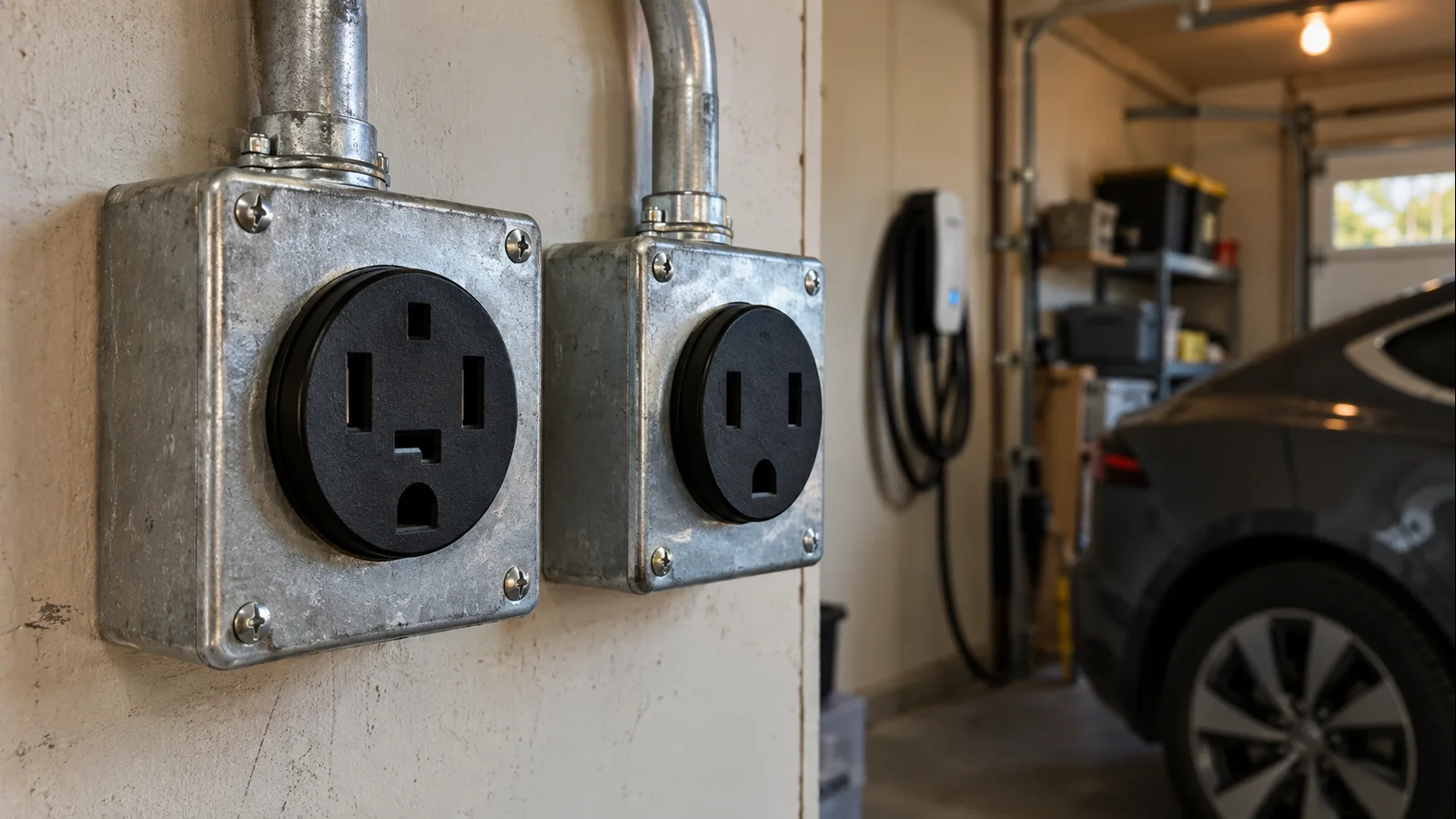
NEMA 14-50 vs. NEMA 6-50 vs. hardwired Level 2
| Option | Why choose it | Key limitation |
|---|---|---|
| NEMA 14-50 receptacle | Portable or plug-in EVSE; common four-wire format | Current still depends on circuit and EVSE; local GFCI rules may affect design |
| NEMA 6-50 receptacle | Plug-in EVSE that specifically supports 6-50; approved configurations can avoid a neutral conductor | Not supported by every EVSE; still needs correct circuit and listed hardware |
| Hardwired EVSE | Permanent installation, outdoor use, or higher settings when the product requires it | Less portable; cost still depends on panel capacity, route, permits, and local requirements |
ChargePoint notes that its NEMA 6-50 option does not require the additional neutral conductor used by the 14-50 option, which may slightly reduce material cost on some runs. That is configuration-specific, not a blanket rule. The electrician must follow the EVSE instructions, conductor requirements, locally adopted electrical code, and the authority having jurisdiction.
Hardwiring removes the receptacle-and-plug connection from the power path and can enable current settings a product does not permit through a receptacle. It is not automatically cheaper, and it is not correct to call every hardwired installation safer than every receptacle installation. Equipment quality, conductor sizing, terminations, breaker selection, environmental protection, commissioning, and inspection still matter.
For permanent wall units, see Wallbox Pulsar Plus vs. Tesla Wall Connector and AmpedHabitat’s look at the ChargePoint Home Flex.
The hidden installation costs are in the electrical work
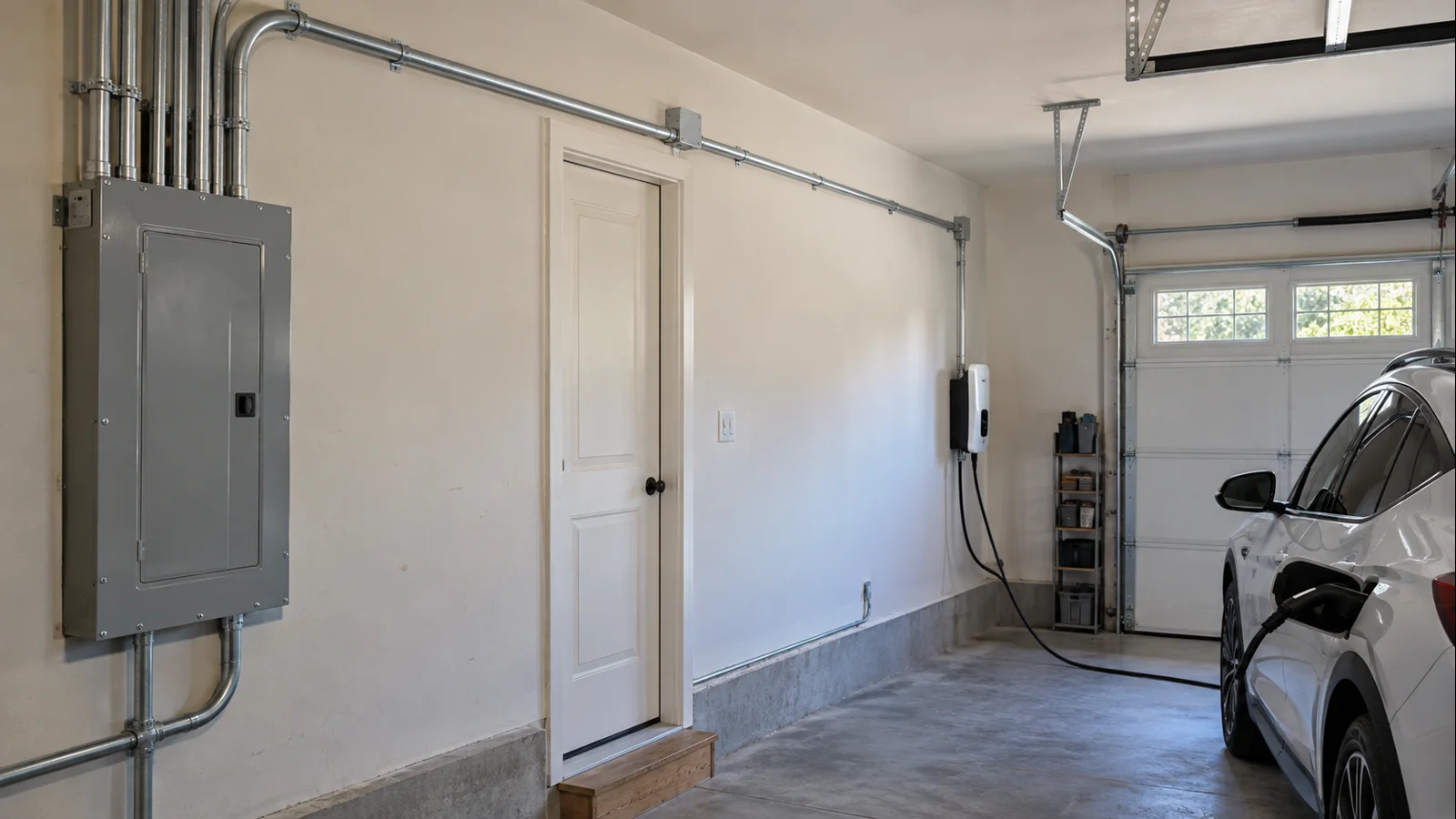
A quote that says only “install 240V outlet” is not detailed enough to compare. The expensive part can be everything required to make that outlet or hardwired EVSE appropriate for the house.
- Panel and service capacity: An electrician may need a load calculation before adding a large continuous load. Empty breaker spaces do not prove the service has enough capacity.
- Breaker and GFCI requirements: Receptacle-based EV charging can be subject to GFCI requirements under locally adopted code. ChargePoint says that where local code requires a GFCI breaker for plug-in Home Flex, it recommends hardwiring because added GFCI protection can cause nuisance tripping with that product’s internal protection.
- Route length and wiring method: A charger beside the panel is different from one across a finished basement, attic, detached garage, or long exterior wall. Conduit, fittings, supports, and conductor length add labor and material.
- Wall access or trenching: Fishing conductors through finished walls or trenching to a detached structure can dominate the quote. Tesla’s home-charging guidance also flags long runs, trenching, panel work, and concealed cable as complexity drivers.
- Receptacle, enclosure, and terminations: Hardware should match the EVSE manufacturer’s requirements. ChargePoint’s current guide calls for an industrial-grade NEMA 14-50 or 6-50 outlet for plug-in Home Flex. Box size, conductor bending space, terminal torque, and workmanship matter.
- Permits and inspection: Requirements and fees vary by jurisdiction. A quote should state whether permitting and inspection coordination are included.
- Outdoor installation: Weather-resistant equipment, suitable enclosures, watertight fittings, and location-specific protection may be needed.
- Load management: In some homes, an approved compatible load-management system can keep EV charging within available electrical capacity instead of forcing the highest fixed-current design. Approval and commissioning are installation-specific.
For details on when electrical capacity is the limiting factor, see our guide to EV load management, panel upgrades, and other Level 2 charging paths.
Installation is a one-off; electricity is the recurring cost. To see what the running side actually adds up to in your state, use the EV charging cost calculator.
How to compare electrician quotes without chasing a fake national price
There is no useful universal installation price because two “50A outlet” jobs can have very different scopes. Ask bidders to quote the same configuration and identify the circuit rating, intended EVSE current setting, breaker type, conductor and wiring method, route length, receptacle or hardwire hardware, permit, inspection, wall repair or trenching, outdoor fittings, load management, and any panel or service work.
Tell the electrician the exact EVSE and vehicle before the circuit is designed. Oversizing solely for a headline rate can spend money without shortening charging time if the vehicle’s onboard charger accepts less AC power. A smaller circuit can be reasonable when overnight parking easily replaces normal daily driving. Tesla’s current guidance explicitly allows lower Wall Connector configurations when the electrical supply cannot support the maximum setting.
Watch for heat at a plug-in charging connection
High-current charging runs for hours, so a poor receptacle connection or loose termination can become a heat problem. Warning signs include a plug or receptacle that becomes unusually hot, discoloration, a burnt odor, softened or deformed plastic, crackling, or repeated interruption associated with the connection.
Do not open an outlet box, EVSE, or electrical panel or attempt to retorque conductors while energized. If there is visible damage, abnormal heat, odor, or evidence of arcing, stop using the circuit and have a qualified electrician inspect it before charging resumes. Avoid improvised extension-cord solutions; see the AmpedHabitat guide to EV charger extension cords.
What about the federal EV charger tax credit in late 2026?
The federal Section 30C Alternative Fuel Vehicle Refueling Property Credit no longer applies to property placed in service after June 30, 2026. The IRS individual guidance says the amended credit applied to eligible property placed in service from January 1, 2023 through June 30, 2026, and the Form 8911 instructions confirm the termination date.
That does not make every earlier installation eligible. For personal-use property, a prior claim can still depend on the placed-in-service date, principal-residence requirement, eligible census tract, documentation, and other IRS rules. Use current IRS instructions or a qualified tax professional rather than treating an EVSE receipt as automatic eligibility.
FAQ
Is a NEMA 14-50 faster than a NEMA 6-50?
No, not by receptacle name alone. If the circuit, EVSE setting, voltage, and vehicle acceptance are the same, the receptacle type itself does not create extra charging power.
Can I charge at 48A from a 50A receptacle?
Not as a general rule. ChargePoint limits its 50A-circuit plug-in Home Flex configuration to 40A charging, while Tesla Mobile Connector is capped at 32A on its NEMA 14-50 and 6-50 adapters. Follow the exact EVSE instructions and circuit design.
Do I need a 60A circuit for home charging?
No. A 60A circuit can support 48A charging on equipment designed for it, but the right target depends on vehicle AC acceptance, daily energy use, parking time, panel capacity, and future plans.
Is hardwiring always better than an outlet?
No. Hardwiring is attractive for permanent installations and may be required for higher settings on some EVSEs. A receptacle can make portable equipment easier to remove or replace. Either approach should match the equipment, circuit, environment, and local code.
Source freshness: Technical and tax guidance checked against current ChargePoint, Tesla, U.S. Department of Energy AFDC, and IRS materials available in September 2026. Electrical requirements vary by product and locally adopted code; installation should follow listed equipment instructions and local authority requirements.