

Short answer: Wallbox Pulsar Plus and the standard Tesla Wall Connector are both capable permanent Level 2 chargers, but the better fit depends on connector type, wiring method and power-management needs. Pulsar Plus offers 40A and 48A North American models with J1772 or NACS configurations; Tesla’s standard Wall Connector is a hardwired NACS unit rated up to 48A. Neither guarantees 11.5 kW at the vehicle.
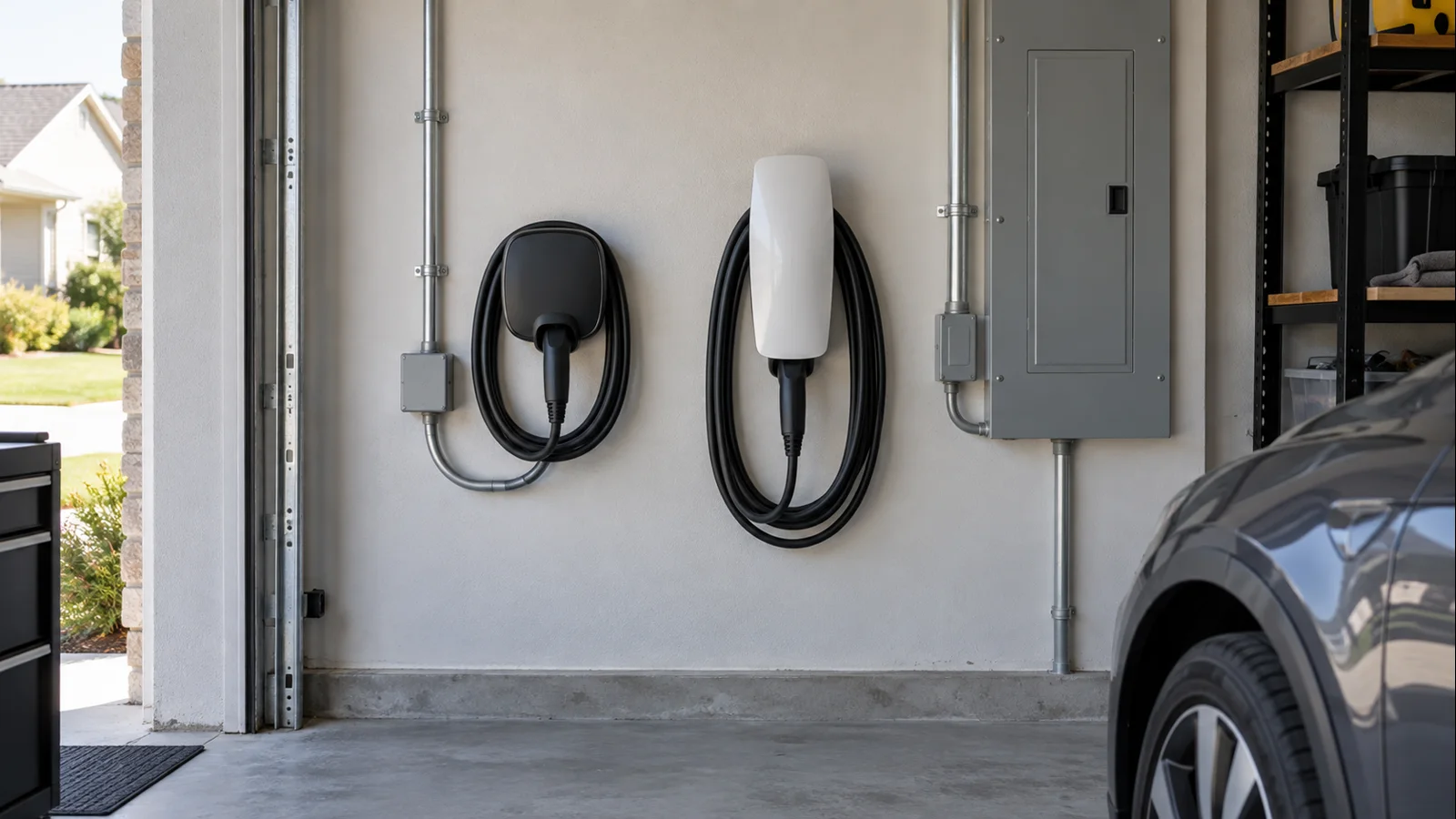
Wallbox Pulsar Plus vs Tesla Wall Connector: what actually differs in 2026?
The two products overlap on maximum Level 2 charging power, so the decision is usually about installation and compatibility rather than raw speed. Wallbox’s current North American Pulsar Plus family includes 40A and 48A models. The 40A model can be NEMA 14-50 plug-in or hardwired; the 48A model is hardwired. Wallbox’s current datasheet lists both SAE J1772 and NACS connector configurations, so the old claim that Pulsar Plus is J1772-only is stale.
Tesla’s current standard Wall Connector is a hardwired Level 2 EVSE with up to 48A output, a 24-foot cable, Wi-Fi, app management and indoor/outdoor capability. Keep it separate from the Tesla Universal Wall Connector, which is a different product with an integrated J1772 adapter.
At 240V, 48A is about 11.5 kW and 40A is about 9.6 kW. Those are EVSE-side maximums, not guaranteed battery charging rates. The car’s onboard AC charger, commissioned current limit, supply voltage and load-management controls can all reduce actual power. If charging is slower than expected, AmpedHabitat’s Level 2 charging diagnostic guide explains how to separate EVSE, circuit and vehicle limits.
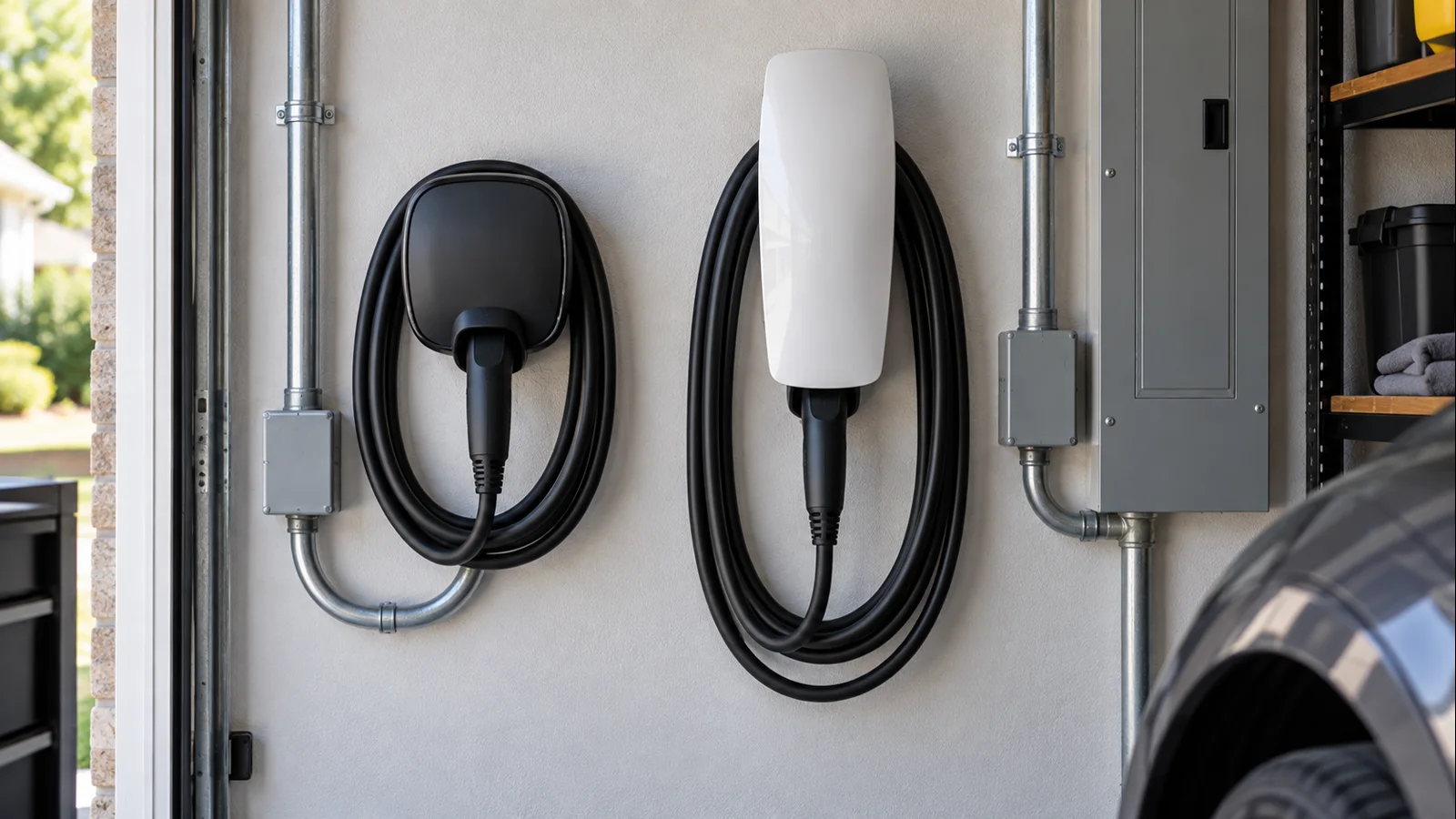
Practical comparison table
| Feature | Wallbox Pulsar Plus (North America) | Tesla Wall Connector (standard) |
|---|---|---|
| Maximum EVSE output | 40A or 48A; about 9.6 kW or 11.5 kW at 240V | Up to 48A; about 11.5 kW at 240V |
| Connector choice | Current datasheet lists SAE J1772 and NACS | NACS |
| Cable length | 25 ft | 24 ft |
| Plug-in option | 40A: NEMA 14-50 or hardwired; 48A: hardwired | Hardwired |
| Connectivity | Wi-Fi, Bluetooth, Wallbox app and portal | Wi-Fi and Tesla app |
| Power management | Static Load Management listed; dynamic functions depend on compatible meter/accessory and setup | Static, Dynamic and Group Power Management; Dynamic requires approved meter |
| Outdoor rating | NEMA Type 4 | Type 3R / IP54 |
| Residential warranty | 3-year limited warranty | 4 years for normal residential use |
Connector choice: NACS or J1772?
Connector choice still matters in 2026 because the cable must match the vehicle inlet or be used with an appropriate adapter. It does not determine charging speed by itself. A 32A-limited vehicle will not take 48A simply because the EVSE is capable of it.
Pulsar Plus gives homeowners a broader native-connector choice because Wallbox’s current North American documentation lists both J1772 and NACS. Exact SKUs can vary by connector, amperage and wiring configuration, so verify the specific unit before ordering.
The standard Tesla Wall Connector is a straightforward fit for NACS vehicles. In a mixed NACS/J1772 household, it is not automatically the best universal choice. Tesla’s Universal Wall Connector is a separate alternative with an integrated J1772 adapter, while Wallbox offers connector-specific Pulsar Plus configurations. Choose around the vehicles that will actually use the charger most often.
For legacy or used smart-EVSE context, see the JuiceBox 40 review.
Hardwired vs NEMA 14-50
This is one of the clearest differences. Wallbox offers a 40A Pulsar Plus that can use a NEMA 14-50 plug or be hardwired. The 48A Pulsar Plus is hardwired. Tesla’s standard Wall Connector is hardwired.
A plug-in installation is not automatically cheaper. Receptacle quality, GFCI rules under locally adopted code, conductor route, panel capacity, permits and outdoor protection can matter more than the receptacle itself. AmpedHabitat’s 240V outlet cost guide explains why total project scope matters more than a national “outlet price.”
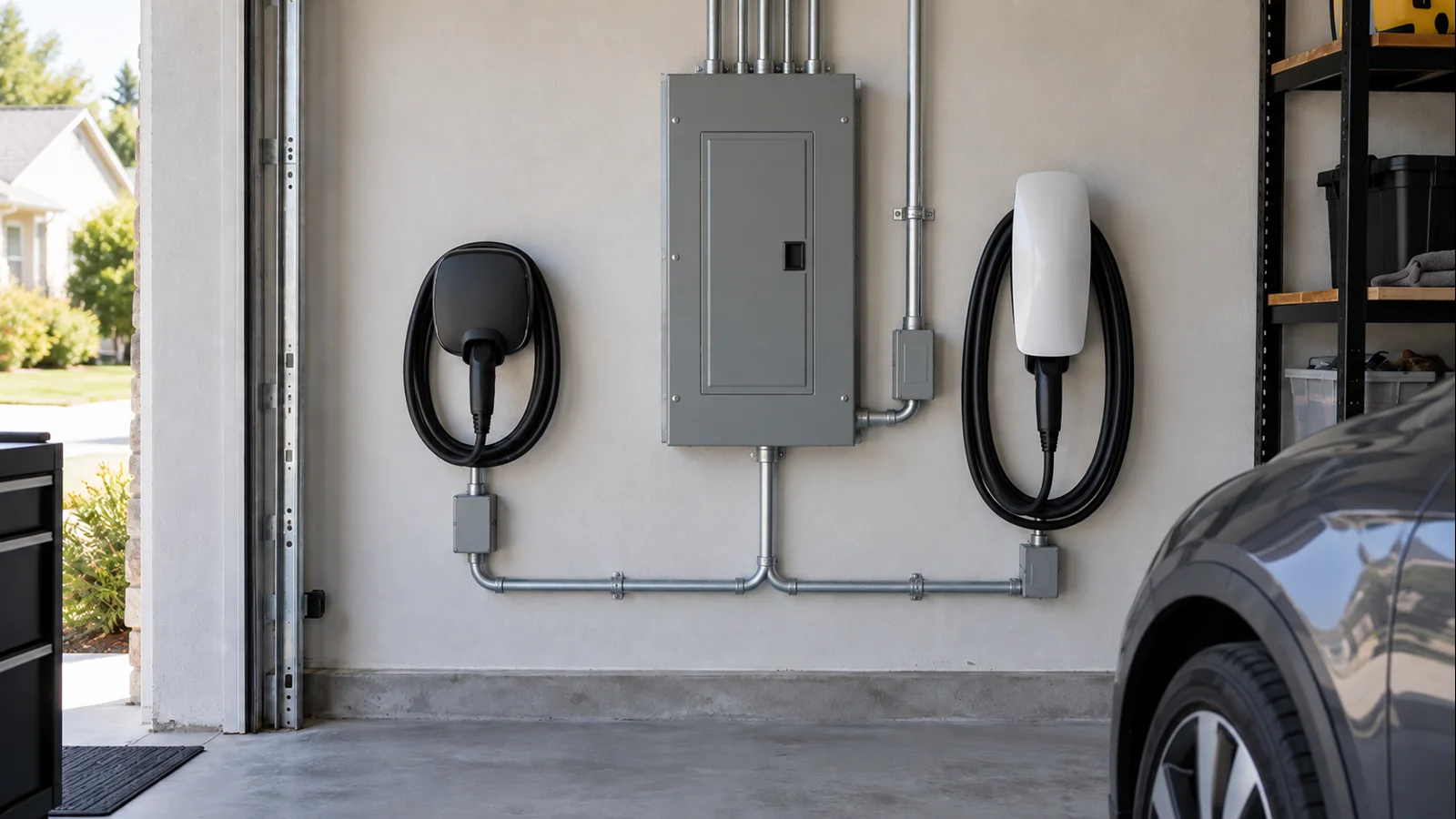
Panel capacity and load management
A 48A setting is not necessary or even useful for every home. Tesla’s current guidance maps 48A output to a 60A circuit and 40A to a 50A circuit, with lower output settings available for smaller circuits. Wallbox also allows configurable current up to the selected model’s rated maximum. A proper load calculation and the vehicle’s AC acceptance limit should drive the target.
Wallbox’s current Pulsar Plus datasheet lists Static Load Management as an included feature. Dynamic energy management is more configuration-dependent: whole-home dynamic control requires compatible metering/accessories and correct commissioning. It should not be treated as automatically included in every installation.
Tesla’s Power Management suite includes Static, Dynamic and Group modes. Static sets a fixed maximum during commissioning. Dynamic adjusts charging current based on available panel capacity and requires a Tesla-approved power meter sold separately. Group Power Management coordinates multiple Gen 3 Wall Connectors. These features can help avoid unnecessary electrical upgrades in some homes, but they do not guarantee full-rate charging at all times.
App, connectivity and daily use
Wallbox provides Wi-Fi and Bluetooth with control through its app and portal. Tesla uses Wi-Fi and the Tesla app for registration, schedules, usage data, access controls and management. A Tesla owner may value keeping charging inside the same app ecosystem, while a multi-brand household may prefer Wallbox’s more brand-neutral software environment.
Neither software platform changes the car’s onboard AC charging limit. If the vehicle can only accept 7.7 kW AC, a 48A EVSE remains limited by the car.
Outdoor installation and cable reach
Both units are designed for indoor/outdoor use, but the published enclosure ratings differ: Wallbox lists NEMA Type 4, while Tesla lists Type 3R / IP54. Correct siting, wiring entries, clearances and local requirements still matter.
Cable reach is nearly identical: 25 feet for Pulsar Plus versus 24 feet for Tesla. Measure the actual parking geometry before the circuit is installed, including charge-port location and whether the car is parked nose-in or backed in. A well-placed EVSE is preferable to planning around an extension cord; see AmpedHabitat’s EV charger extension-cord safety guide.
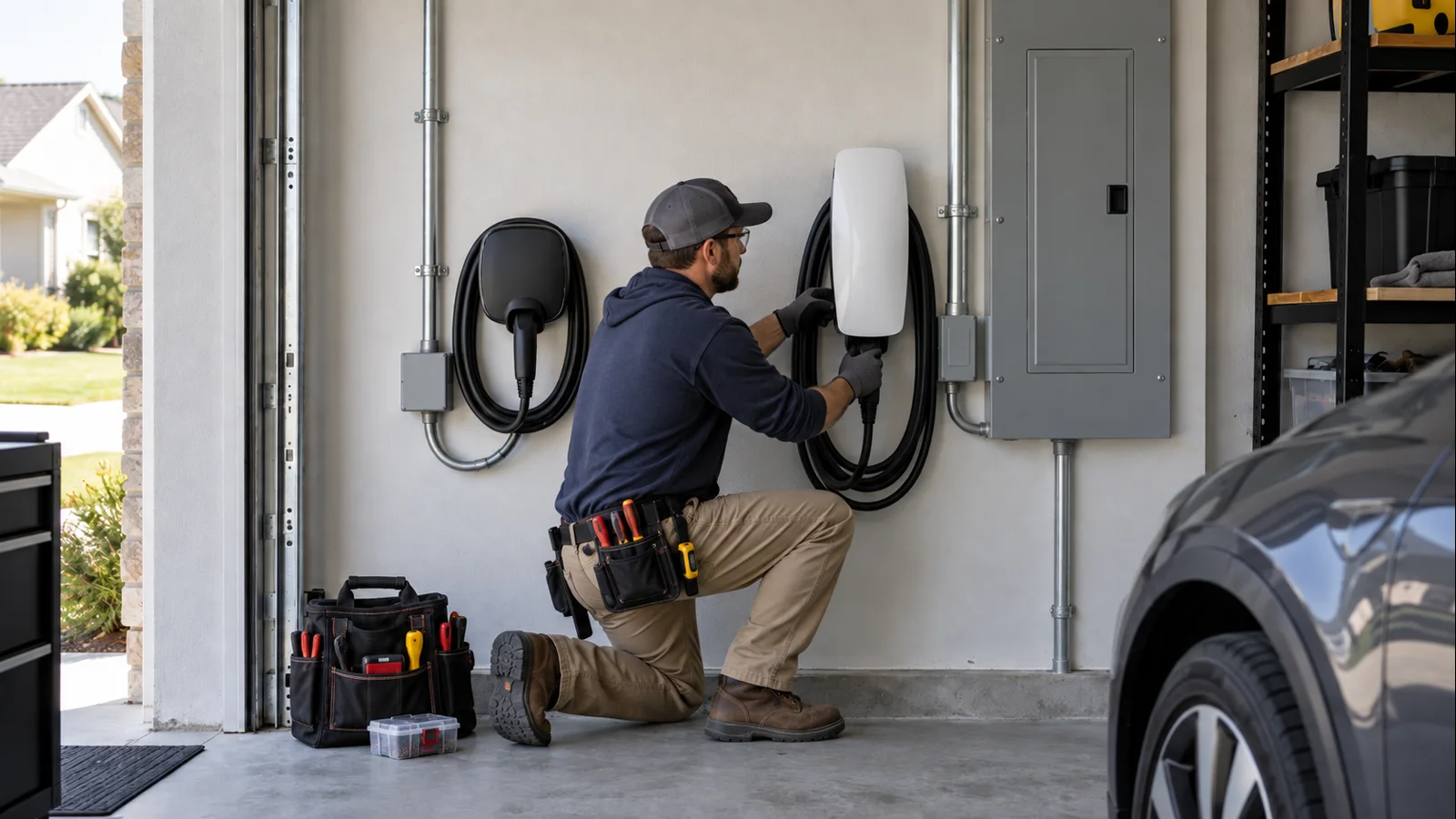
Warranty, support and total installed cost
Wallbox’s U.S. limited warranty currently covers Pulsar Plus for three years under its stated terms. Tesla states four years for normal residential Wall Connector use from the invoice date. Read the exclusions and service process, not just the headline term.
Total installed cost can vary far more than the charger hardware price. Panel work, conductor length, trenching, conduit, permits, load-management equipment and difficult routing can dominate the quote. A charger beside a capable panel is a different job from one in a detached garage or a home needing service changes.
For Tesla drivers, check the car before paying to maximize circuit size. The Tesla Model Y charging guide shows why vehicle-side AC limits can matter as much as the EVSE rating.
Which one should you choose?
Pulsar Plus makes sense when you want J1772 or NACS connector choice, need a 40A NEMA 14-50 plug-in option, or prefer the Wallbox app and energy-management ecosystem. The standard Tesla Wall Connector makes sense when your vehicles use NACS, you want a hardwired installation integrated with the Tesla app, or Tesla’s Power Management features fit the electrical design.
There is no universal winner. Start with four facts: vehicle connector, vehicle maximum AC acceptance, available electrical capacity and preferred wiring method. Those factors usually decide the comparison more reliably than brand preference.
FAQ
Which is faster: Wallbox Pulsar Plus or Tesla Wall Connector?
At 48A, both can supply about 11.5 kW at 240V. Wallbox also offers a 40A model at about 9.6 kW. Real charging speed is capped by the EVSE setting, circuit/configuration, supply voltage, controls and the vehicle’s onboard AC charger.
Does NACS versus J1772 matter in 2026?
Yes for physical compatibility, but not because one connector is inherently faster for Level 2 charging. Wallbox currently lists both J1772 and NACS Pulsar Plus configurations; Tesla’s standard Wall Connector is NACS.
Can either charger plug into a NEMA 14-50 outlet?
The 40A Pulsar Plus has a NEMA 14-50 configuration. The 48A Pulsar Plus is hardwired. Tesla’s standard Wall Connector is hardwired rather than a NEMA 14-50 plug-in product.
What if my panel cannot support 48A charging?
Both products can operate below maximum output, and both brands provide power-management approaches. Dynamic management requires compatible meter hardware and correct setup. Have a qualified electrician perform the load calculation and design the circuit for the specific house and EVSE.
Which is better for a mixed-EV household?
It depends on the connector mix and how often each vehicle charges. Wallbox offers J1772 and NACS Pulsar Plus configurations. Tesla’s standard Wall Connector is NACS, while the separate Universal Wall Connector integrates a J1772 adapter.
Source freshness: Manufacturer facts were checked September 10, 2026 against the Wallbox Pulsar Plus North America datasheet, Wallbox U.S. warranty terms, the current Tesla U.S. Wall Connector listing, Tesla Power Management guidance and the Tesla Gen 3 installation specifications. Verify the exact SKU and local installation requirements before purchase.