

Quick answer: Eaton’s current U.S. residential smart-breaker option is the AbleEdge family: retrofit-friendly, two-pole Wi-Fi breakers for selected Eaton BR loadcenters that add circuit-level metering, remote control and load management without replacing the whole panel. They can be useful for EV charging and battery-backup load shedding, but they are not transfer equipment, whole-panel monitoring by themselves or a universal shortcut around service-capacity and code requirements.
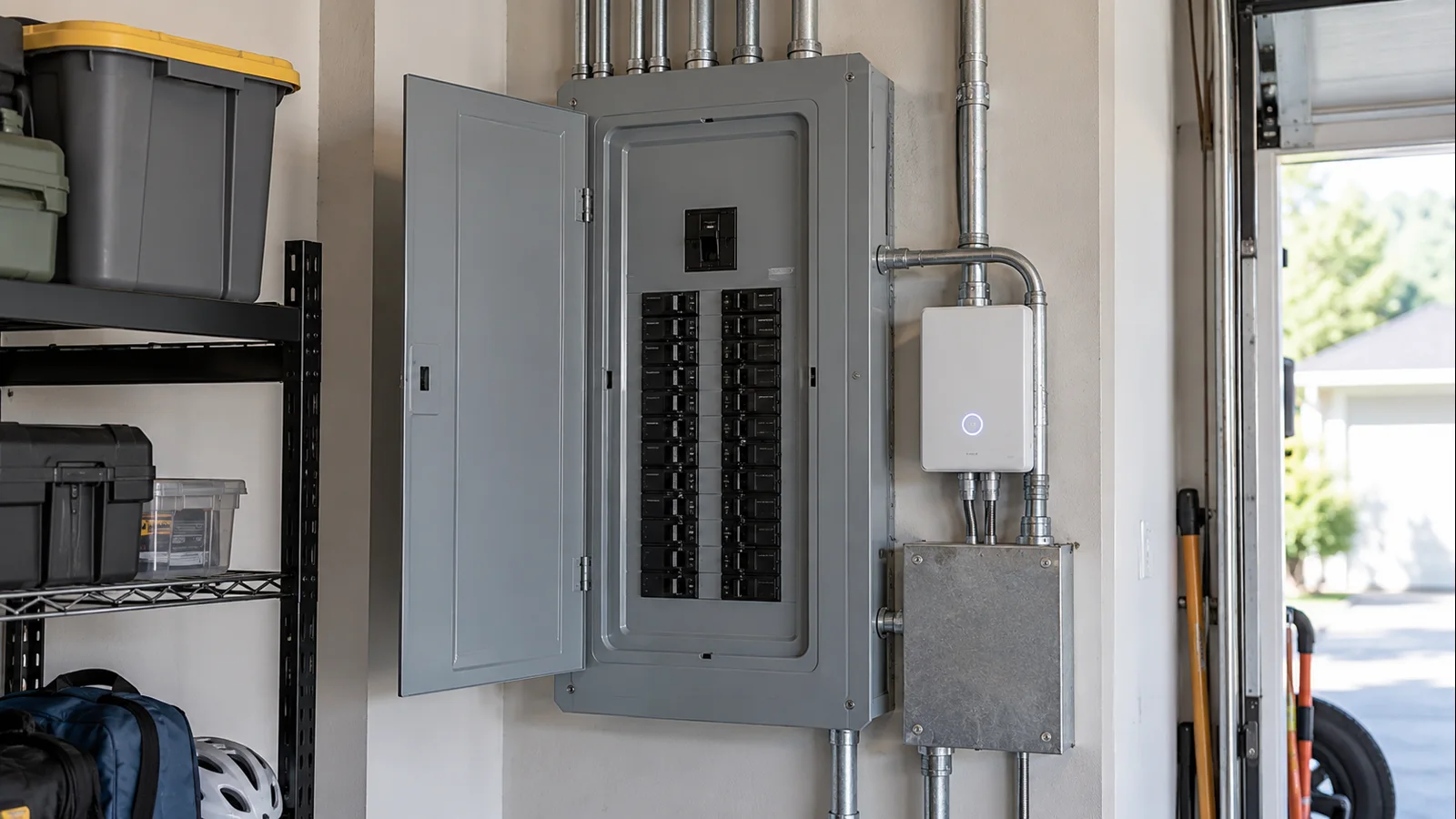
What Eaton’s current smart breaker actually is
As of September 2026, Eaton’s residential smart-breaker line is AbleEdge. Eaton says AbleEdge replaces the first-generation EMCB smart breakers, so older EMCB specifications should not be treated as current.
Eaton’s current specification sheet lists two-pole 15, 20, 30, 40, 50 and 60A models. They take two loadcenter spaces, use a BRS plug-on style, are rated 120/240V or 120/208V at 60Hz and carry a 10kAIC interrupting rating. The sheet also lists UL 489 and UL 943 certifications, a 10-year mechanical warranty and a 3-year electronics warranty.
The family is aimed at residential single-phase loads such as EV chargers, water heaters, dryers and other larger circuits. Eaton’s FAQ says the current AbleEdge lineup is two-pole only, includes Class A GFCI protection, does not include AFCI protection and is not offered as a three-pole residential product.
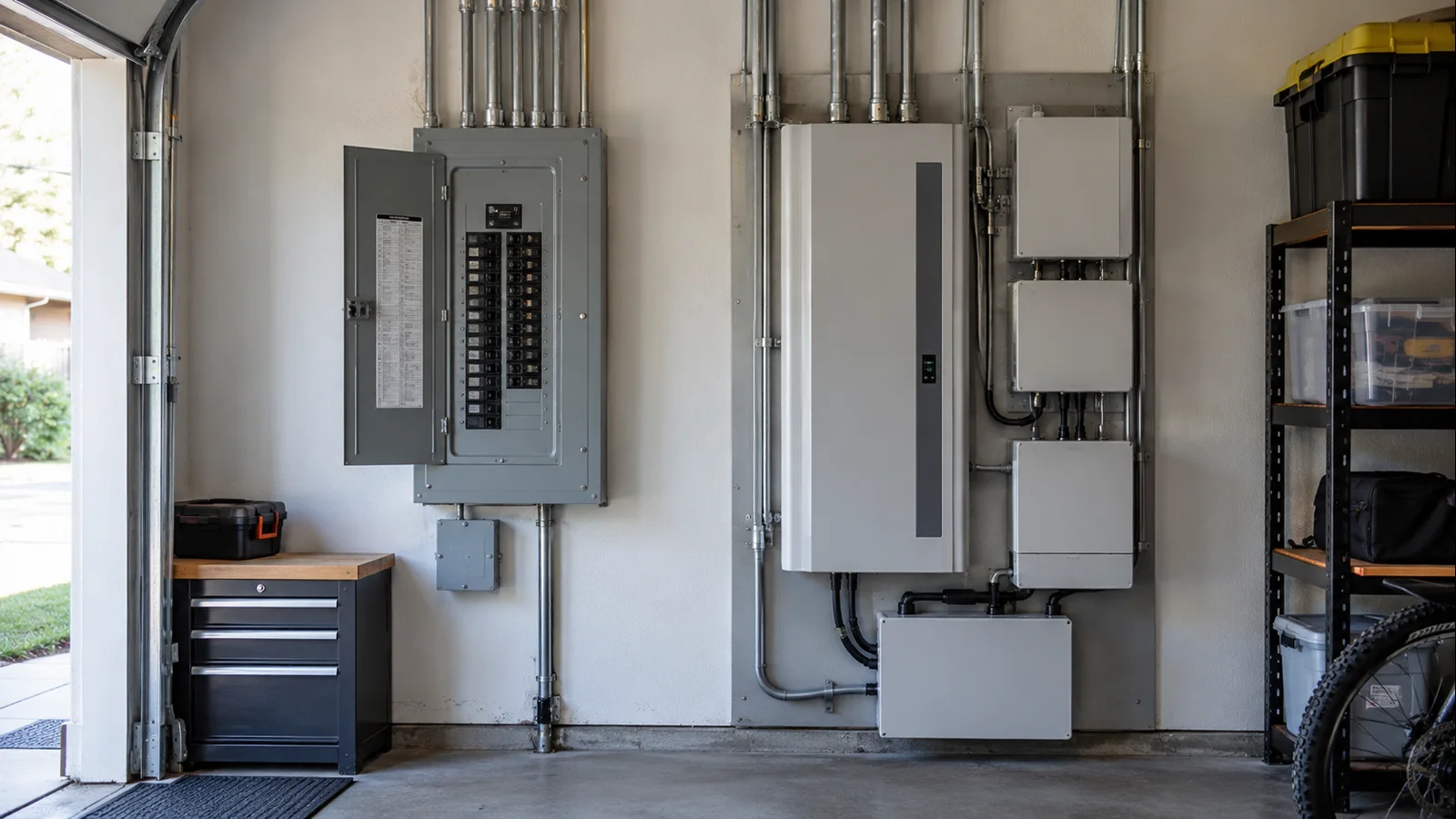
Smart breaker vs monitor vs load manager vs smart panel
| Equipment | What it does | Key limit |
|---|---|---|
| AbleEdge smart breaker | Measures and controls one compatible branch circuit | Does not monitor every circuit or island a home from the grid |
| Whole-home monitor | Measures total consumption, sometimes selected circuits | Monitoring does not automatically equal load control |
| Load-management system | Coordinates flexible loads to stay within a defined limit | Must still satisfy listed-system, NEC and AHJ requirements |
| Transfer/gateway equipment | Provides required utility isolation or transfer for backup | Does not add battery capacity or circuit metering by itself |
| Full smart panel | Provides broad circuit-level monitoring and control | Still needs compatible backup equipment and code-compliant design |
Eaton also sells a separate Smart Panel with SPAN Energy Intelligence. That is a different product family: a smart loadcenter platform with broad circuit-level monitoring/control and SPAN energy-management features. If an existing Eaton BR panel is healthy and only a few large loads need intelligence, AbleEdge is the more targeted retrofit. If the panel already needs replacement and whole-panel visibility is the goal, the SPAN-based option belongs in the comparison.
A smart panel can be one HEMS component rather than the whole control strategy; AmpedHabitat's HEMS guide explains the distinction between circuit hardware, monitoring, and system-level coordination.
What homeowners actually get
AbleEdge reports voltage, current, frequency, power and cumulative energy, with Eaton documenting revenue-grade metering accuracy of ±0.5%. It also reports breaker state such as open, closed or tripped. That makes it useful for seeing the actual energy use of a selected 240V load rather than estimating from nameplate ratings.
Remote operation uses a controllable internal contact that is separate from the thermal-magnetic trip mechanism. Eaton’s FAQ says the handle does not move when the circuit is opened or closed wirelessly. A genuine thermal-magnetic trip cannot simply be reclosed remotely; a physical reset is required.
For standard homeowner use, AbleEdge connects to a customer-supplied 2.4GHz Wi-Fi network and uses Brightlayer Home for monitoring, switching and schedules. Eaton does not list a separate Eaton gateway as a basic requirement for those functions. Third-party battery or backup systems may still require their own controller, gateway and transfer hardware.
Cloud dependence and fail-safe behavior
Eaton states that overload, short-circuit and GFCI protection continue if internet connectivity is lost. The breaker also keeps accumulated energy locally as a rolling counter and can synchronize it after connectivity returns.
The scheduling feature is more dependent on the cloud: Eaton says schedules are not stored locally and are executed through Brightlayer Home, so scheduled actions require internet connectivity. Eaton also documents local access and APIs for integrations, but a homeowner who wants every automation to operate independently of cloud service should verify the intended integration before buying.
EV charging: a strong use case
A Level 2 EV circuit is an obvious AbleEdge candidate because it is large, flexible and easy to meter separately. The breaker can show circuit energy use, schedule availability and participate in load-management logic. Eaton also documents a load-interlock feature that can keep selected high-demand loads from operating simultaneously when configured by a qualified person.
That does not mean remote-off capability automatically lets a home avoid a service upgrade. The EVSE, breaker, conductor sizing, continuous-load rules, service/load calculation, locally adopted NEC edition, equipment listing, installer configuration and AHJ acceptance all matter. For the charging circuit itself, see AmpedHabitat’s guides to 240V outlets for EV charging and slow Level 2 charging.
Battery backup, solar and load shedding
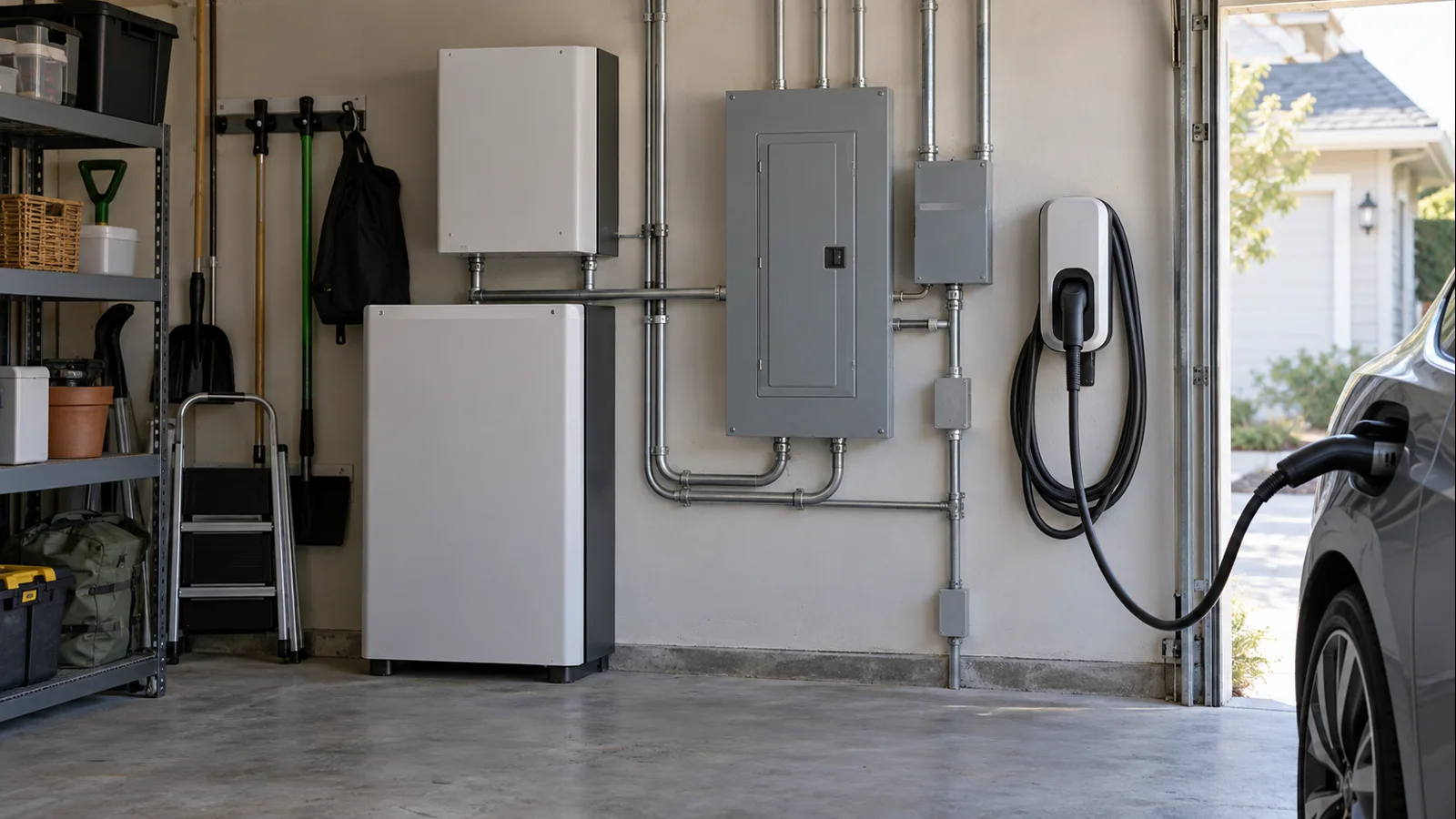
Smart breakers can be valuable during battery backup because shedding a noncritical 240V load reduces instantaneous demand. That can help keep demand within the battery inverter’s power output in kW and can slow consumption of the battery’s stored energy capacity in kWh. Those are separate limits: a smart breaker can reduce load, but it does not increase battery kWh or inverter kW.
Eaton documents automatic load shedding for backup operation, but AbleEdge is not transfer equipment. A battery-backed home still needs an approved architecture for utility isolation, transfer and inverter coordination. Likewise, do not assume a smart breaker is automatically an approved solar interconnection device unless the exact Eaton and inverter documentation supports that configuration.
Compare storage hardware first in AmpedHabitat’s Best Home Batteries (2026) guide, then decide which loads benefit from smart control. The power-outage preparation guide is useful for prioritizing essential versus flexible loads.
Retrofit constraints that can decide the project
“Eaton BR” is not enough information to order. Eaton maintains a detailed compatibility list for residential loadcenters and meter breakers. AbleEdge uses a neutral pigtail and fits both standard BR and plug-on-neutral loadcenters, but some listed meter-breaker configurations have location or ampacity restrictions. Eaton notes that certain 40A–60A installations require an optional wire accessory kit, while some specific meter-breaker models are limited to 30A.
The two-pole-only lineup is another practical limit. AbleEdge can make selected large loads smart, but it cannot currently replace every ordinary single-pole branch breaker in a home.
Who should buy it, and who should skip it?
Best fit: a homeowner with a compatible Eaton BR loadcenter who wants detailed metering and control on a few large 240V loads, especially EV charging or backup-load shedding, while keeping an otherwise serviceable panel.
Skip or compare alternatives: homes with incompatible panels; projects needing one-pole smart control; installations requiring more than the current 10kAIC rating; homeowners wanting comprehensive whole-panel circuit data; or anyone who requires cloud-independent scheduling. If the existing panel already needs replacement, compare a full smart panel instead of adding intelligence circuit by circuit.
Installer checklist before ordering
- Match the exact loadcenter or meter-breaker catalog number to Eaton’s current compatibility list.
- Confirm the required two-pole amperage, breaker position and any neutral-bar or wire-kit restriction.
- Verify 10kAIC is appropriate for the available fault current at the installation.
- Confirm whether the connected equipment needs GFCI, AFCI or another protection arrangement.
- For EV charging, complete the service/load calculation and verify the EVSE’s listed current setting.
- For backup, identify transfer equipment, battery kWh, inverter kW and the loads to be shed.
- Confirm reliable 2.4GHz Wi-Fi at the panel and whether cloud-based scheduling is acceptable.
- Use a qualified electrician for installation and commissioning.
Verdict
Eaton AbleEdge is a credible late-2026 retrofit for adding accurate circuit metering and controllable load management to compatible Eaton BR panels without replacing the whole loadcenter. Its strongest use is selective control of large flexible loads. Its limits are equally important: two-pole only, 15A–60A, 10kAIC, cloud-dependent schedules, exact compatibility requirements and no substitute for transfer equipment or approved electrical-system design.
For the right BR installation, that focused approach can make more sense than replacing a healthy panel. For homeowners who want every circuit monitored and controlled—or who already need a new panel—Eaton’s separate SPAN-based smart-panel platform is the better category to evaluate.
FAQ
Does AbleEdge work in every Eaton panel?
No. Eaton says it fits a wide range of BR-style loadcenters and meter breakers, but the exact catalog number must be checked against the current compatibility list.
Can AbleEdge automatically control an EV charger?
It supports remote switching, scheduling and load-management functions. Whether those functions can be used for a code-approved service-capacity strategy depends on the complete listed system, local code and AHJ approval.
Will it still protect the circuit if Wi-Fi goes down?
Yes. Eaton states that overload, short-circuit and GFCI protection continue without internet access. Cloud-based schedules do not continue normally because they are not stored locally.
Does one AbleEdge breaker monitor the whole house?
No. It meters the branch circuit it serves. That is different from whole-panel monitoring or a full smart panel.
Can it replace a battery gateway or transfer switch?
No. It can help control loads, but it does not by itself provide utility isolation, automatic transfer or the complete architecture needed for islanded battery backup.
Source check: September 2026. Consequential product details were checked against Eaton’s current U.S. AbleEdge product page, specification sheet, FAQ, compatibility documentation and Eaton Smart Panel with SPAN Energy Intelligence materials. Electrical design and code acceptance vary by installation and jurisdiction.