

How much solar panels save in summer depends on your actual production, household load, and utility tariff—not on a universal summer percentage. The bill math is straightforward: solar kWh used in your home avoid the applicable grid import rate, exported kWh receive whatever credit your utility plan specifies, and fixed or non-bypassable charges may remain. That is why a very high-production month can still leave you with a meaningful electric bill.

Summer Solar Savings Start With Bill Math, Not Panel Output Alone
A solar array can produce a large amount of electricity in a sunny summer month and still fail to erase the bill. Production is only one side of the equation. The other side is how much electricity the home uses at the same time, how the utility values imports and exports, and which charges remain regardless of solar production.
The cleanest way to think about a grid-tied solar bill is:
- Self-consumed solar: each kWh used directly by the home avoids buying that kWh from the grid at the applicable import price for that time or billing period.
- Exported solar: each kWh sent to the grid earns the credit, compensation, or rollover treatment defined by the actual utility tariff.
- Grid imports: electricity the home still pulls from the grid is billed under the utility's rate structure.
- Fixed and non-bypassable charges: some charges can remain even when net energy use is very low.
The U.S. Department of Energy notes that solar savings depend on electricity consumption, system size and production, utility rates, and how excess solar is compensated. It also warns that net-metering rules vary by state and utility, so the actual tariff matters more than a generic national assumption. See DOE's Homeowner's Guide to Solar.
kW Is System Size; kWh Is Energy Produced
Homeowners often mix up kilowatts (kW) and kilowatt-hours (kWh). A residential array's kW rating describes its power capacity under defined test conditions. Monthly or annual production is measured in kWh.
For example, a 7 kW DC solar array is not expected to produce 7 kWh every hour of daylight. Real energy production changes with solar resource, weather, sun angle, array orientation and tilt, shading, module temperature, inverter limits, soiling, wiring and conversion losses, and other system conditions. NREL's PVWatts Calculator uses system size in DC kW along with location and system assumptions to estimate energy production in kWh.

Why Summer Can Be Productive Without Guaranteeing Maximum Savings
Long summer days and strong solar resource can make summer an important production season in many U.S. locations, but there is no valid universal summer-versus-winter production percentage. The pattern can differ sharply between Arizona, coastal California, the Pacific Northwest, the Northeast, Florida, and other regions.
Daily and monthly yield depends on weather and solar resource, array azimuth and tilt, shading, losses, cloud patterns, and inverter behavior. Orientation can also shift the hourly production profile, which matters under time-of-use pricing.
Soiling can reduce output, but cleaning should be condition-based rather than automatic. Our guide to solar panel cleaning covers monitoring, local conditions, roof access, and manufacturer guidance.
Heat Reduces Module Power, but "Hotter Means Less Summer Energy" Is Too Simple
Solar modules are rated under standard test conditions, including a 25°C cell temperature. As cell temperature rises above the reference condition, module power generally declines according to the module's power temperature coefficient. The exact coefficient is product-specific, so the datasheet should be checked instead of assuming one number for every panel.
NREL's current PVWatts/SAM documentation models temperature effects and uses module-type-specific assumptions in its simplified performance model. But temperature is only one variable. A hot, clear summer day can still generate substantial daily energy because irradiance and daylight are strong; a cooler cloudy day can produce less. Hot weather by itself therefore does not determine daily or seasonal kWh yield.
Long-term output also changes gradually as modules age. For the difference between warranty language, degradation, and useful life, see our guide to solar panel lifespan and degradation.
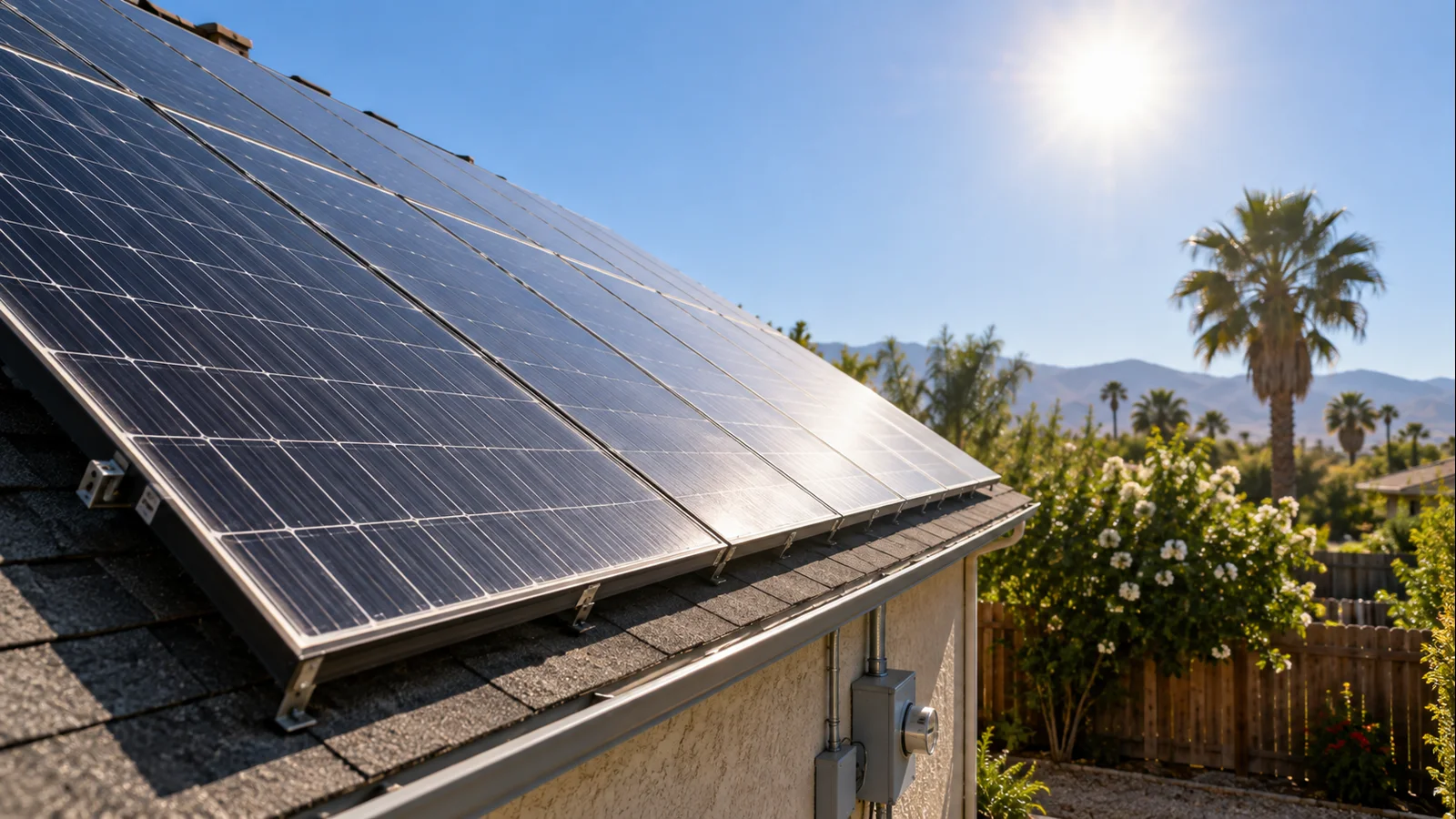
A Worked Summer Bill Example
These numbers are assumptions for explaining the math only. They are not a forecast, national average, or recommended system size.
| Assumption | Example value |
|---|---|
| Household electricity use during the month | 1,000 kWh |
| Solar production during the month | 900 kWh |
| Solar used directly in the home | 500 kWh |
| Solar exported to the grid | 400 kWh |
| Grid imports | 500 kWh |
| Example import rate | $0.20/kWh |
| Example export credit | $0.08/kWh |
| Example fixed/non-bypassable charges | $18 |
Without solar, this simplified bill would be: 1,000 kWh × $0.20 + $18 = $218.
With solar, the home buys 500 kWh from the grid: 500 × $0.20 = $100. The 400 exported kWh receive 400 × $0.08 = $32 in credits. Add the $18 fixed charges: $100 - $32 + $18 = $86.
In this hypothetical case, the bill reduction is $218 - $86 = $132. The same 900 kWh of solar production could produce a different dollar result under a different export rate, time-of-use structure, minimum bill, seasonal rate, credit rollover rule, or non-bypassable charge.
Exports, Net Metering, and Time-of-Use Rates Change the Value of a Solar kWh
A common savings error is valuing every solar kWh at the full retail import rate. That is only valid when the tariff gives that treatment.
Self-consumed solar generally avoids the applicable import charge for electricity that otherwise would have been purchased at that time. Exported solar is different: compensation can be retail-like, avoided-cost-based, time-varying, capped, rolled forward, or structured another way. Net metering and export programs are utility- and state-specific.
Time-of-use rates add another layer. A kWh avoided during an expensive evening period may be worth more than a kWh avoided during a lower-priced midday period. Solar production often peaks before evening household demand does, so hourly timing can matter even when the monthly production total looks excellent.
Because export terms change what each kilowatt-hour is worth, they belong in any payback estimate. The solar savings calculator takes your export credit as a separate input and applies your state’s retail rate to the rest.
Why a High-Production Summer Month May Still Have a Bill
A non-zero bill is not proof that the solar system is underperforming. Common reasons include high air-conditioning demand, nighttime grid use, reduced compensation for midday exports, fixed customer charges, non-bypassable fees, time-of-use pricing, or a billing period that does not align neatly with the calendar month.
Clipping can also affect the production curve. If the DC array can deliver more power than the inverter can convert at a given moment, the inverter limits output. NREL's modeling tools account for inverter and system losses, which is one reason a simple "panel watts × sun hours" calculation is usually too crude for bill planning.

Does Adding a Battery Automatically Increase Summer Savings?
No. A battery can move solar energy from one time of day to another and can provide outage resilience, but that does not automatically make it financially attractive.
The economic value depends on the spread between export compensation and later import prices, time-of-use rates, round-trip efficiency, control strategy, usable battery capacity, incentives, equipment cost, and how much the homeowner values backup power. In a tariff with generous exports, storing each surplus kWh may have less financial value than under a tariff that pays little for exports but charges much more for evening imports.
Our 2026 home battery guide compares equipment and use cases, but sizing should start with loads, tariff details, and resilience goals.
How to Estimate Your Own Summer Solar Production and Savings
Start with NREL PVWatts using the home's location, system DC kW rating, array type, tilt, azimuth, and realistic losses. Treat the result as an estimate, not a production guarantee. PVWatts itself cautions that performance predictions include assumptions and uncertainty.
Then obtain the actual utility tariff. Identify the import price structure, export compensation, time-of-use periods, fixed charges, minimum bills if applicable, credit rollover rules, and any non-bypassable charges. Finally, compare modeled or monitored solar production with the home's interval or monthly consumption. For existing systems, inverter monitoring plus utility interval data can reveal how much solar is self-consumed versus exported.
For issues with coordinating solar production and EV charging, see the SolarEdge EV Charger solar-sync troubleshooting guide.
FAQ
Why isn't my summer electric bill zero even when solar production is high?
Because the bill depends on more than total solar kWh. You may still import electricity at night or during heavy air-conditioning use, receive less than the retail rate for exports, or owe fixed and non-bypassable charges. Time-of-use rates can also change the value of imports and exports by hour.
Do solar panels produce less because summer is hot?
Higher cell temperature generally reduces instantaneous module power relative to the module's reference condition, based on its temperature coefficient. But summer energy yield also depends on irradiance, daylight, weather, orientation, shading, losses, and clipping. Heat alone does not determine the month's total kWh.
Is exported solar always credited at the same rate I pay for electricity?
No. Export compensation is defined by the utility and state rules that apply to the account. Some tariffs may provide retail-like credits; others use different values or time-dependent structures. Check the current tariff rather than assuming full retail net metering.
What is the best way to estimate summer solar production?
Use a location-specific tool such as NREL PVWatts with accurate system inputs, then compare the estimate with installer modeling or real monitoring data if available. Avoid relying on a universal July kWh figure or a generic summer production percentage.
Freshness and Sources
Reviewed for late-2026 accuracy on September 10, 2026. Primary references: NREL's PVWatts Calculator, NREL's PVWatts/SAM model documentation, and the U.S. Department of Energy's Homeowner's Guide to Solar. Utility bill rules, net-metering terms, export compensation, and time-of-use periods can change; verify the tariff for the actual service address before making a savings decision.